

This page serves as a lens for anyone seeking clarity and guidance on the role of “Customer Success / Customer Experience / Digital Transformation / Customer Service” particularly in Vietnam SaaS.
There are many titles given to those who work directly with customers and build lasting relationships—ultimately driving revenue and retention for the company. In SaaS, the software itself is important, but how it helps customers generate revenue is even more critical. Thus, a strategic role was born, positioned between the company and the customer and given various titles such as “Customer Success / Customer Experience / Digital Transformation / Customer Service“.
Through personal experience and research, this seeks to shed light on a role often overlooked, yet so essential that even AI cannot replace its human value.
Abbreviations
1. Customer Success: CS
2. Customer Experience: CX
3. Digital Transformation: DT
Table of content
1. The history of the roles
2. Some misunderstandings
3. The scopes of work
4. Some challenges
5. Personal experience & Determination for this paper
6. My essential framework
7. The prospects of the role in Vietnam
Disclaimer
Citation
1. The history of the roles
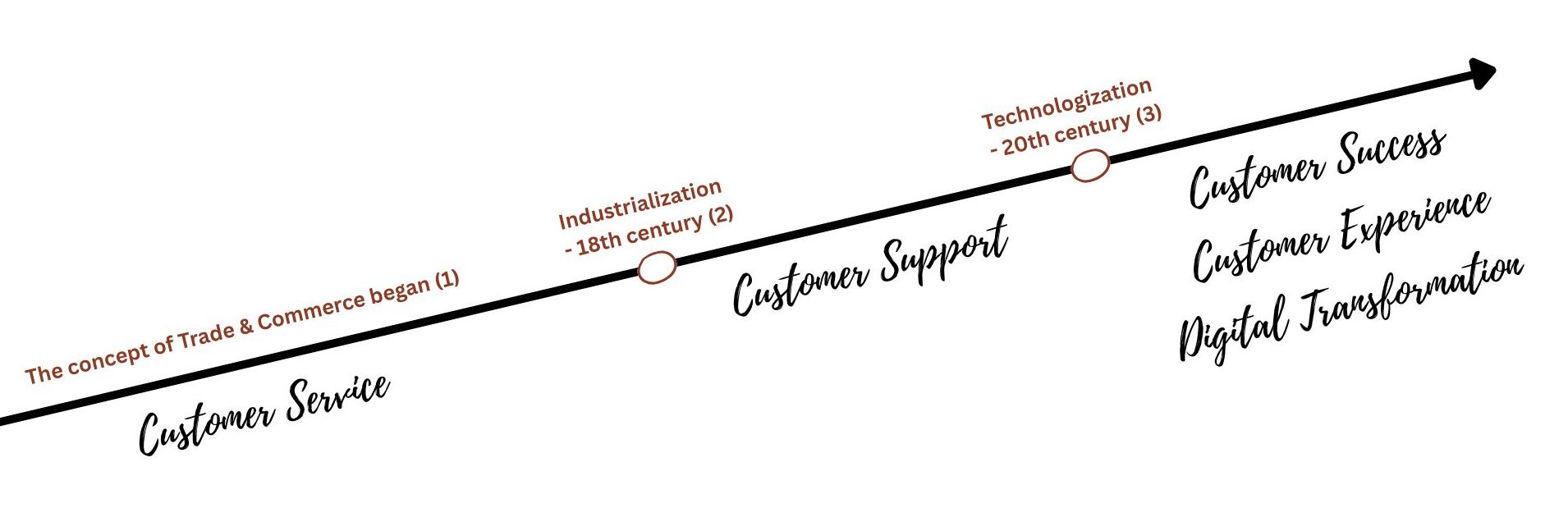
All these roles share a common goal: fostering and maintaining strong relationships between customers and businesses.
In that context, customer service can be traced back to ancient Greece and Rome, where early forms of customer interactions began in the trade and commerce, and was later developed during the Industrial Era. (1)
Products invented during the Industrialization period became increasingly specialized and competitive, requiring customers to invest time in learning how to use them and resolving technical issues. This growing complexity made sales more challenging and underscored the need for someone capable of effectively bridging the gap between customers and the technical aspects of the products. This is how customer support began to take a shape. (2)
Customer Success later emerged alongside the rise of the technology era, where designated individuals acted as advocates for customers within their own organizations. (3)
Customer Experience should not be grouped together with Customer Service, Support or Success, as it encompasses the entire customer journey – from the moment of initial interest through to post-sale engagement and beyond. (4)
3. Some challenges
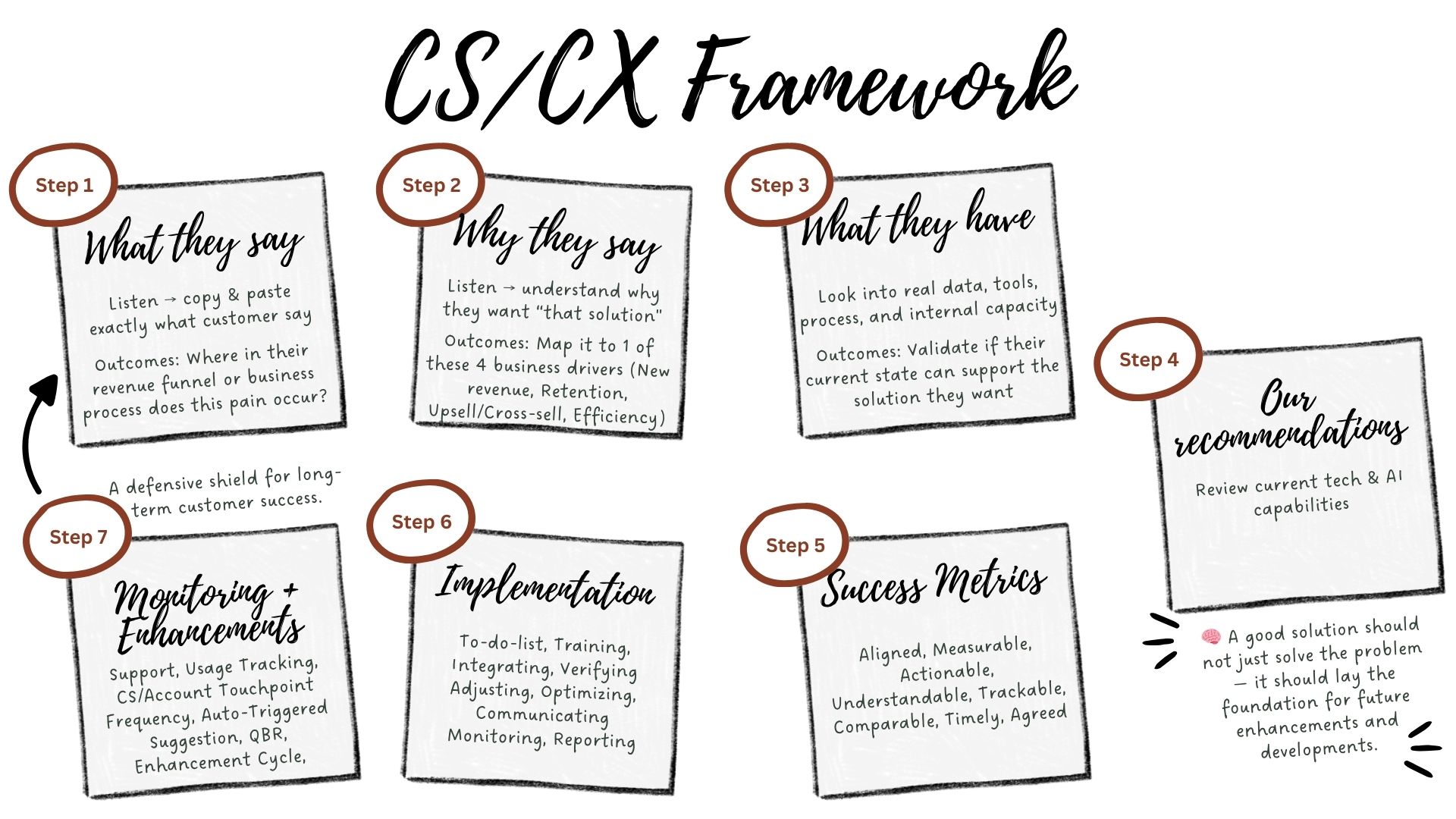
5. My essential framework
Disclaimer
This paper is based on personal experience and perspective. While it may serve as a helpful reference, it is not officially endorsed by any professional institution and should not be cited as a formal academic source.
Citation
1. Fullview. (n.d.). The history of customer service. Retrieved July 16, 2025, from https://www.fullview.io/blog/history-of-customer-service
2. Gold Mountain Communications. (2022, April 18). The history of customer support. Retrieved July 16, 2025, from https://www.goldmtn.com/history-of-customer-support/
3. Customer Success Association. (n.d.). The history of customer success – Part 1. Retrieved July 16, 2025, from https://www.customersuccessassociation.com/library/the-history-of-customer-success-part-1/
Unger, T. (n.d.). Where did customer experience come from? A CXO’s brief history. Retrieved July 16, 2025, from https://www.toddunger.com/post/where-did-customer-experience-come-from-a-cxo-s-brief-history
4. Lemon, K. N., & Verhoef, P. C. (2016). Understanding customer experience throughout the customer journey. Journal of Marketing, 80(6), 69–96. Retrieved July 16, 2025, from https://www.xavierquerathement.fr/wp-content/uploads/2018/07/1-Lemon-et-Verhoef-2016.pdf